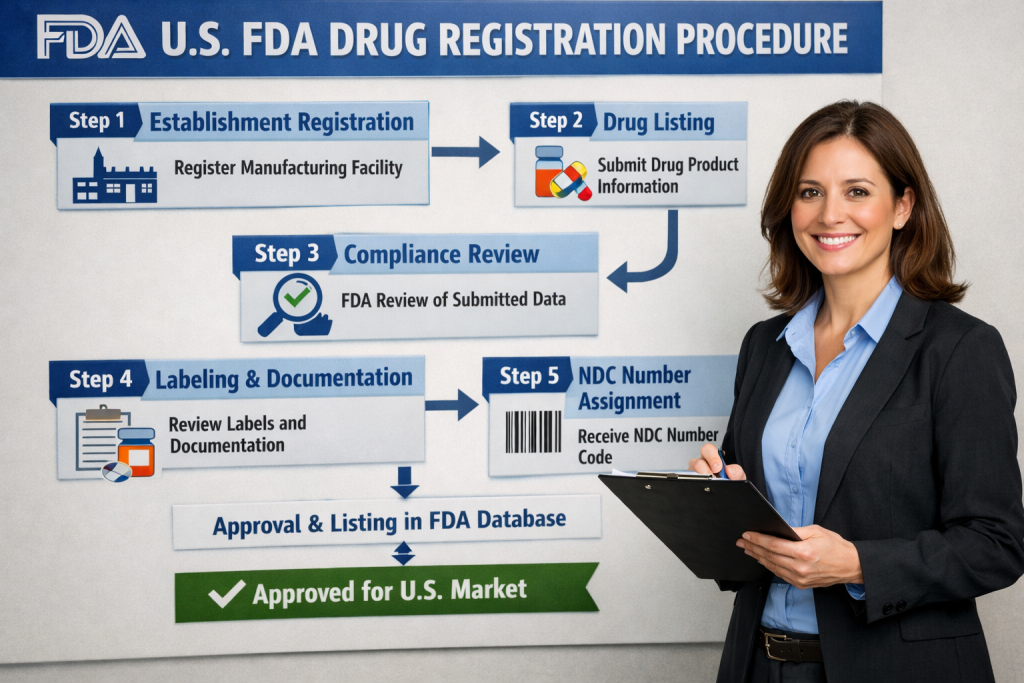
The US FDA drug registration procedure is a core regulatory requirement for companies planning to introduce pharmaceutical products into the United States market. Any organization involved in manufacturing, processing, packaging, labeling, or testing drugs for the US must comply with registration and listing obligations set by the U.S. Food and Drug Administration.
What US FDA Drug Registration Really Means
US FDA drug registration is primarily about facility registration and product listing, not marketing approval. Registration establishes your legal presence with the FDA, while approvals (such as NDA or ANDA) determine whether a specific drug can be marketed. Many companies confuse these two steps, which often leads to compliance delays.
Step 1: Define Your Drug Establishment Activities
Start by identifying what activities your facility performs. These may include API manufacturing, finished dosage manufacturing, repackaging, relabeling, or testing. Each activity must be accurately declared, as the FDA uses this information to determine inspection scope and compliance expectations.
Step 2: Assign a US FDA Agent
If your establishment is located outside the United States, appointing a US FDA Agent is mandatory. The agent acts as the FDA’s local point of contact for inspections, emergency communications, and regulatory correspondence. Selecting a knowledgeable agent reduces response time and ensures regulatory clarity.
Step 3: Register the Drug Establishment
Drug establishment registration is completed through the FDA’s electronic registration system. Companies must submit legal entity details, facility address, and operational information. This registration is annual and must be renewed every year within the FDA’s designated renewal window to remain valid.
Step 4: Submit Drug Listings
Each drug product manufactured or marketed for the US must be listed individually after establishment registration. Drug listing includes formulation details, dosage form, route of administration, labeling information, and manufacturing site linkage. Successful listing generates a US FDA registration number, which is often requested by importers and distributors.
Step 5: Maintain Ongoing Compliance
Registration alone does not guarantee long-term compliance. Facilities must follow US FDA cGMP requirements and remain inspection-ready at all times. Documentation control, quality systems, and change management play a major role in avoiding regulatory actions or import alerts.
Why Many Companies Choose Expert Support
While the FDA system is accessible, regulatory errors can be costly. Incorrect data entry, delayed renewals, or incomplete listings may disrupt supply chains. Partnering with a specialized US FDA Consultancy helps businesses avoid compliance gaps and maintain uninterrupted market access.
For organizations seeking structured regulatory assistance, XPRO America, a US FDA Consultancy, provides end-to-end support across registration, listing, and compliance management. Regulatory queries or onboarding discussions can be initiated by writing to support@xproamerica.com, where the team coordinates next steps efficiently.
Revised Final Takeaway
US FDA drug registration is less about paperwork and more about regulatory discipline. Companies that treat registration as an ongoing compliance obligation—rather than a one-time task—are better positioned to sustain long-term access to the US pharmaceutical market. A well-managed registration strategy minimizes regulatory risk, supports inspection readiness, and builds confidence with US partners and distributors.
Leave a Reply